Bridging Data Science and Industrial Processes: SCCH’s Modular Analytics Infrastructure
SCCH
In calcination and roasting processes, precision is everything. But turning raw sensor data into actionable insights is often a major bottleneck.
That’s why SCCH has developed a modular analytics infrastructure that seamlessly connects industrial data pipelines with advanced data science and machine learning workflows.
How It Works
The platform integrates data ingestion, streaming, analytical databases, interactive analysis tools, and visualization dashboards within a containerized environment.
Data Ingestion & Streaming: Kafka for real-time data streaming, plus InfluxDB and PostgreSQL for time-series and relational storage.
Analysis & Modeling: Python, Jupyter, and MLflow for interactive development and experiment tracking.
Visualization: Grafana dashboards for live process monitoring.
Automation: A FastAPI interface links directly to the Decision Support System (DSS), enabling automated model training, prediction generation, and batch analysis.
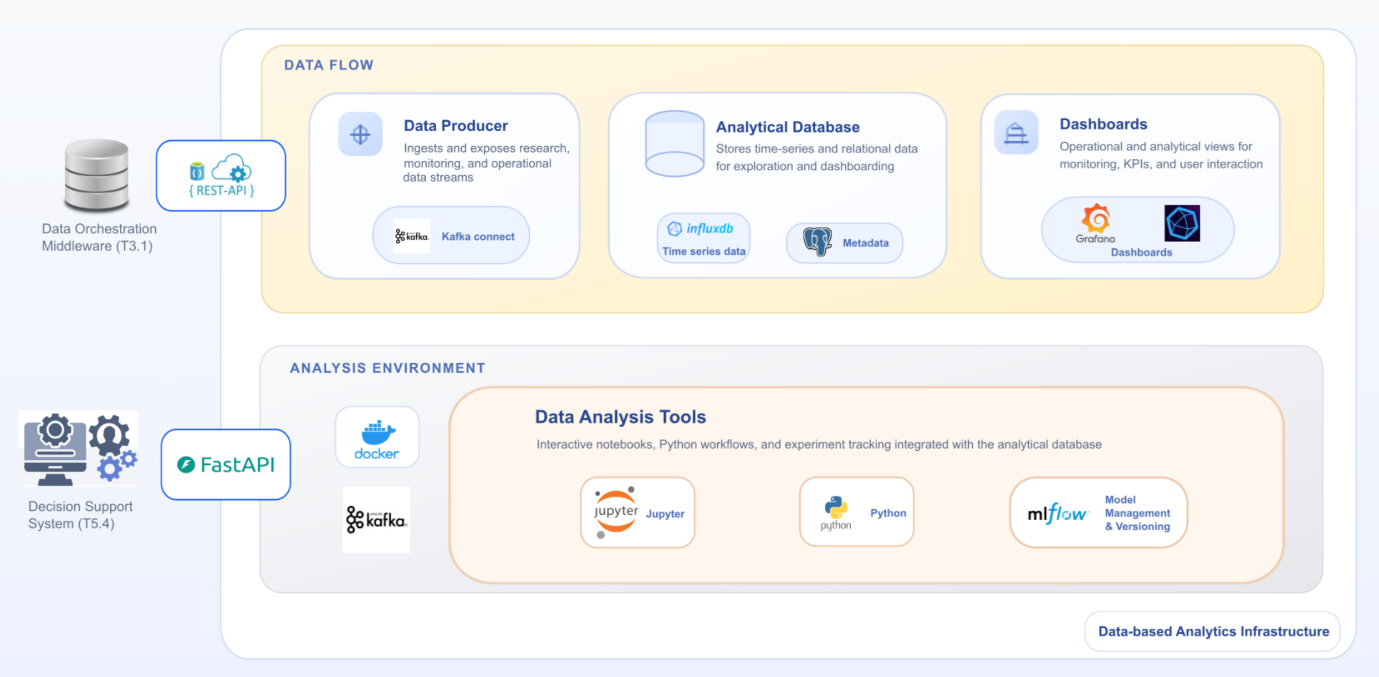
Data-based analytics infrastructure and interconnection with Data Orchestration Middleware and Decision Support System
Through a FastAPI interface, the infrastructure is directly linked to the Decision Support System, enabling automated triggering of analytical tasks such as model training, prediction generation, and batch analysis.
This architecture supports scalable, data-driven decision making for the calcination and roasting processes while ensuring seamless integration with the project’s data orchestration middleware.
What’s next
The upcoming goal of SCCH is to perform a thorough investigation of the accuracy and complexity of data-based and hybrid predictive models for the monitoring and optimization of calcination processes.